
(this is the introduction to a marketing book I am currently writing. Let me know if you are interested in reading more)
INTRODUCTION: The Problem You Don’t Know You Have
Picture this.
You are sitting in that conference room. The marketing team has just presented the latest campaign results. The creative was outstanding, the execution flawless-the metrics looked. okay. Not terrible. Just okay.
But you spent $200,000. The CMO is nodding. The creative director is defending the work. The media buyer is talking about reach and frequency. Everyone did their job. Yet here’s the question nobody asks: “Did we ever really define what we were selling?”
I’ve been in that room hundreds of times. Sometimes as the agency guy. Sometimes as the consultant brought in to figure out why marketing isn’t working. And almost every time, the problem isn’t the campaign.
The problem started way before the ad campaign.
The Scene You Know Too Well
Your sales team is struggling. They’re all saying different things about what you do. Prospects seem confused. Deals take forever to close. The CEO wants to know why marketing isn’t driving more leads.
So what does marketing do?
Launch another campaign.
Better creative this time. Bigger budget. More channels. AI-powered everything.
And six months later, you are back in that conference room wondering why it didn’t work.
Here’s why: You jumped to BRAG without doing WRAP, BAG & TAG.
The Marketing Thought™
Let me show you something that will change how you think about marketing.
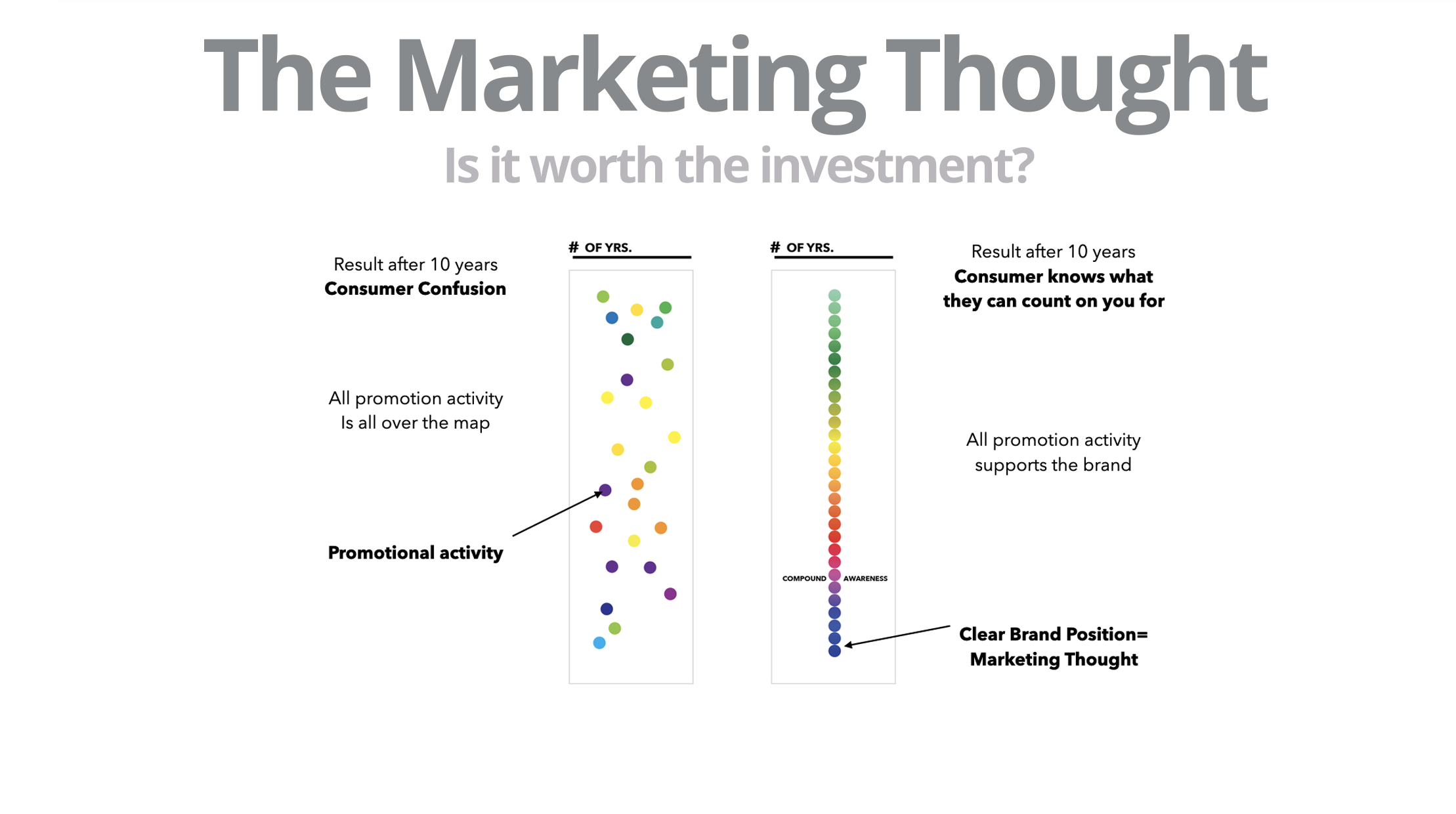
Consider two companies. Both spend the same amount of money, on similar marketing over ten years. Both are running the same number of campaigns. Both have good creative teams and smart marketers.
Company A jumps straight to promotional campaigns. Every quarter brings a new theme, a new message, a new angle. The creative is different each time. The marketing team is busy. Activity looks impressive. But they use their target audience as a pin cushion, trying all sorts of promotional ideas, in order to find something that works.
After ten years – or take any timeframe – their promotional activity is all over the map. Each campaign starts from zero. Nothing builds on anything else. Prospects are confused about what the company actually does. The brand position isn’t clear. The longer this goes on, the more confused the market is.
Result: Consumer confusion. Wasted investment.
What Company B does differently is: before running any campaigns, they get crystal clear on their offering. They define it in language their market understands-customer-first thinking. They package it properly; they brand it professionally.
Then they promote it.
Every promotion activity – every tactic, that is – communicates the same, clear message. Different executions, same essence. The creative changes, but its base is consistent. A Marketing Thought™ is constant and clear.
After a decade, they have created compound awareness. Each campaign adds to the previous one. Prospects know exactly what they can count on the company for. The brand position is rock solid.
Result: Consumer clarity. Investment that compounds.
Same money, same effort: vastly different results.
The difference? Foundation.
The Central Metaphor
“No good picking up speed if you’re on the wrong road.”
A vast majority of companies is speeding down the wrong road. They produce campaigns and tactics with full force. Their creation of content is AI-enabled much faster than ever before. They trumpet their message louder, across each channel.
But they never stopped to ask: Are we on the right road?
Did we clearly define our offering? Did we package it for the market? Did we brand it professionally?
Or did we just jump straight to promoting something that nobody can actually explain?
The AI Urgency
Here’s what makes this critical right now:
With AI, you can now create bad marketing – or as I call it, Repellent Marketing – at industrial scale.
Used to be that bad strategy had natural speed limits. It took weeks to create a confused campaign, time to get it into market, and there were enough people involved in the production process that someone might catch the problem.
Now? You can produce unclear messaging in minutes. You can create scattered campaigns in an instant. You can magnify confusion across every channel at once. At scale.
AI makes execution infinitely faster. That’s great, if your strategy is solid.
If your foundation is broken, it’s catastrophic.
Bad strategy multiplied by AI speed equals disaster at scale.
But here is the flip side: Good strategy × AI speed = compound acceleration.
The companies that get their foundation right can now move faster than ever. The ones that skip foundation are about to waste money faster than they ever imagined possible.
What This Book Will Do
This book will show you the following:
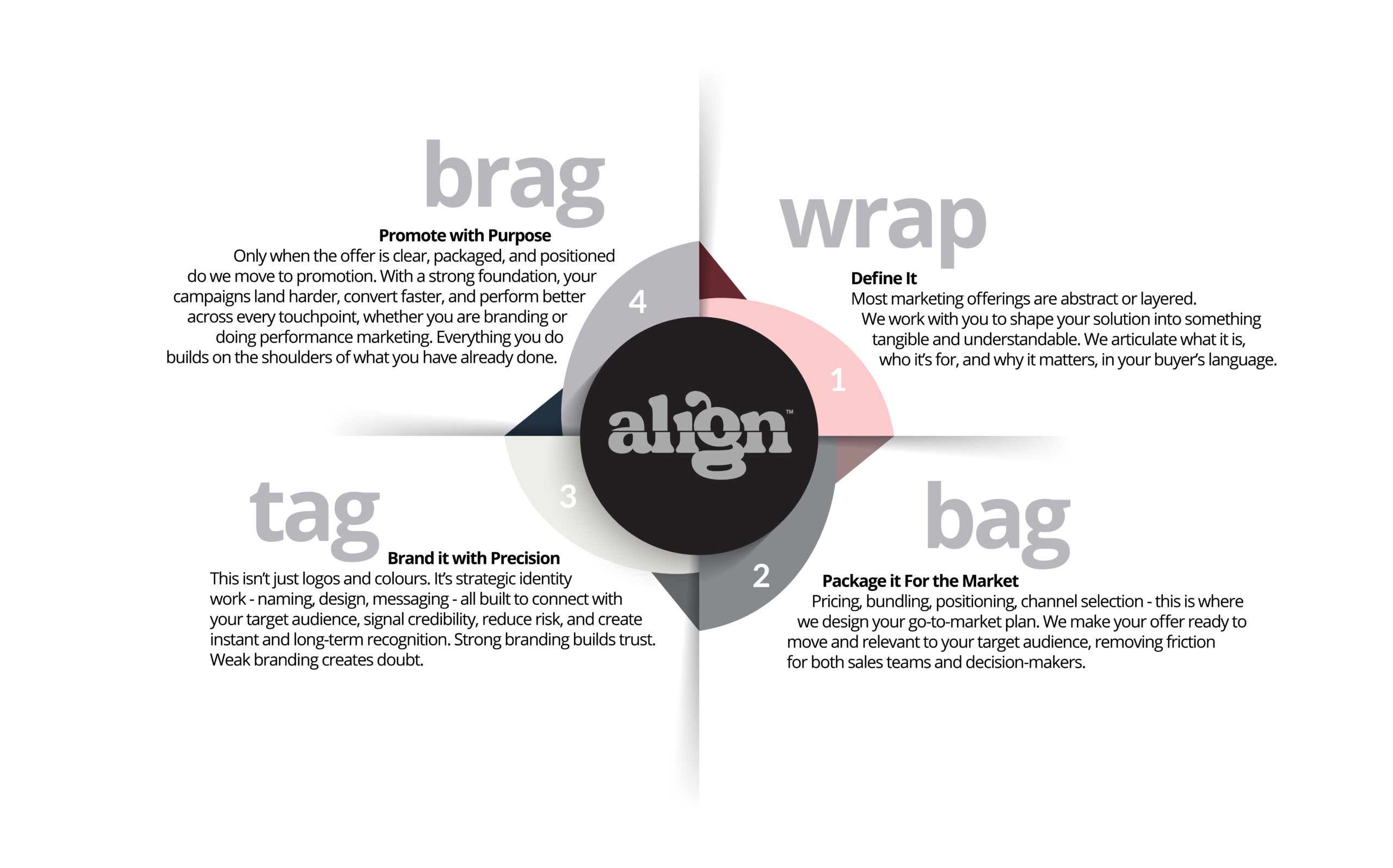
Why most marketing starts at step four – BRAG – when it should start at step one – WRAP – and proceed through BAG, TAG before you BRAG
What this actually costs you in real money
How to walk back through steps one through three of the align process
How to build The Marketing Thought™: your clear and relevant position that compounds awareness over time
How to work one’s way back into the C-Suite through proper budgets and strategic influence
I’ll speak plain English. I’ll use real examples. I’ll provide you with frameworks you can actually use. And I’m going to challenge some assumptions the marketing industry has been making for decades.
Because let’s face it: Most marketing fails at the first step.
Not because marketers are bad at their jobs. But because they’re solving the wrong problem. They’re trying to promote their way out of a definition problem. It doesn’t work.
It has never worked.
And with the amplifying power of AI, it’s about to fail spectacularly.
But if you do the hard work first, if you WRAP, BAG, & TAG before you BRAG, everything changes. Dr Min Basadur calls these ill-defined problems“fuzzy situations”. Taking time to turn that into a clear, relevant and defined problem takes work, proper facilitation and talent. On a larger scale, taking time to lay a strong foundation will pay dividends for many years.
Your campaigns get more effective. Your sales cycles get shorter. Your close rates start to improve. Your marketing budget stops feeling like a cost centre and starts feeling like an investment in growth. Most importantly, you are building something that lasts: something that compounds, something that is a real competitive advantage. That is what this book is about.
Let’s begin.